

Karl Marx (1818-1883) was a philosopher, author, social theorist and economist. He is also known as the father of modern socialism, communism and conflict theory. He is famous for his theories about capitalism and communism. On social theory, Marx forwarded his theory on mode of production. The mode of production is a central concept of Marxism. Mode of production is defined as the way a society is organized to produce goods and services. It basically consists of two major aspects:
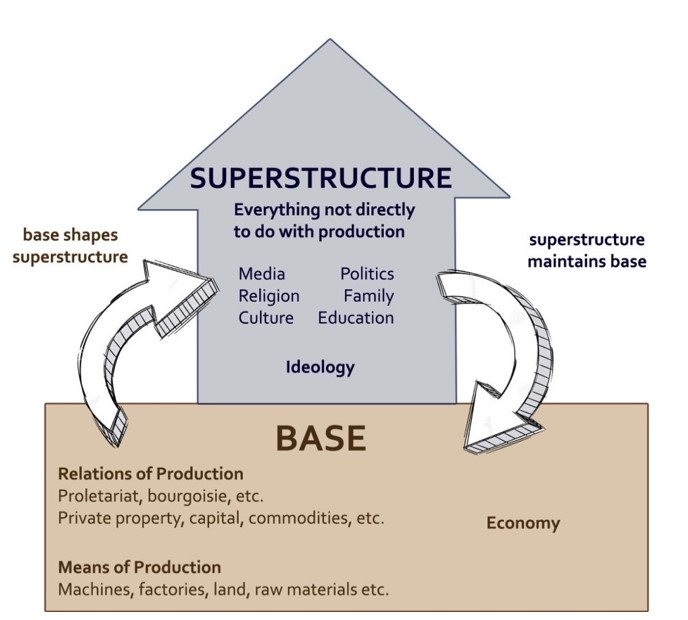
- The forces of production: It includes all of the elements that are brought together in production which will be from land, raw material and fuel to human skill and labor to machinery, tools and factories.
- Relation of production: It includes relationships among people and people’s relationships to the forces of production through which decisions are made about what to do with results.
Marx forwarded the concept that these two: means of production and relation of production are the base of the society which will shape the superstructure and the superstructure helps in maintaining the base. It can be illustrated as:
Following this, Marx forwarded five major modes of production having different social relationships with each other. It can be listed as:
- Asiatic/Primitive mode of production
- Ancient mode of production
- Feudal mode of production/Feudalism
- Capitalist mode of production/Capitalism
- Socialist mode of production/Socialism
It can be further explained as:
– Asiatic/primitive mode of production: In this mode of production, there was absence of private ownership of land. There was the presence of primitive society without the class. It had a very low division of labor. People used to work together for the common goods. It is also known as the hunting and gathering age. Nature was the only means of production for people. At the end of this, it gave rise to a partly organized kinship relationship. This society was without class and conflict.
– Ancient/Slavery mode of production: This mode of production contained slavery as the foundation of the production system. Two different classes as master and slave were formed in this mode of production. The master had the right of ownership over the slave where slaves were basically mobilized for agricultural production. At the end of this, slaves raise their voice against this system which clearly describes that it led to society having class and class conflict. The relation of master and slave is considered as the essence of this mode of production.
– Feudal mode of production: It is also known as feudalism which basically deals with the relationship between the peasant and landowners. This mode of production was essentially a model of agricultural exploitation which was supported by peasants who were responsible for production of goods and were governed by feudal lords.
– Capitalist mode of production: It is also known as capitalism in which capital is the dominant means of production which can be in many forms as money or credit for purchasing physical machinery, labor, power, materials for production etc. In this mode of production, goods are usually produced for sale rather than for their own purpose. Money is used as a medium of exchange where labor power is bought and sold in the market. The production process and financial decisions are controlled by the capitalist. It deals with the relation of capitalist and workers (Bourgeoisie and proletariat)
– Socialist mode of production: Marx viewed that capitalism is a historical phase which will be replaced by socialism. In a purely socialist system, all legal production and distribution decisions are made by the government and individuals rely on the state for everything from food to healthcare. The government determines the output and pricing levels of all goods and services. Basically, socialism is an economic and political system based on public ownership of means of production. It will lead to development of scientific socialism which will again be class and conflict less.
Regarding Nepal, Nepal has also passed through similar phases. Class and class conflict is clearly visible in the context of Nepal. One of the founders of Communist party in 2006 stated that “Most of the land is under the ownership of the feudal ruling class. There is little land under the ownership of peasants” which reflects over feudalism whereas the mean that capitalist mode of production was also unfolded because In Nepal, factories and modern industries are increasing day by day which led to growing workers class. Different personalities have forwarded their ideas regarding the mode of production in the context of Nepal. Some debated that A capitalist society is an industrial society but Nepal is an agricultural society hence Nepal is a feudalist society. Some argued that capitalist society is an urban society but Nepal is predominantly a rural society hence Nepal is feudalist society. Similarly, personalities have also forwarded their concept saying that Nepal is semi feudal.
